Tuesday, August 5, 2014

Un(comfort)able Foods


Last time Nathaniel from The Film Experience picked a couple of short films for the wonderful series Hit Me With Your Best Shot, I started off by saying that short film is in many ways the red-headed stepchild of filmmaking. If only I had saved that observation for this week's edition concerning a trio of short films from Canadian director Jamie Travis! It would have fit perfectly with the three films in question (Why the Anderson Children Didn't Come to Dinner, The Saddest Boy in the World, and The Armoire - all available to view for free online here) which are referred to as Travis' Saddest Children Trilogy. And as a bonus one of the boys is a stepchild (how convenient!) and most of the young boys in it could be considered ginger-esque (okay, now I'm just pushing it). But the comparison of unwanted or unloved children seems to be in keeping with the overall mood of these melancholic, dry-humored shorts in which childhood is observed not with starry-eyed nostalgia but with a darkly sinister and slightly unnerving eye.

Often compared to the intricate, meticulously designed worlds of Wes Anderson, Travis' trilogy does seem to share an aesthetic sensibility to that of the director. Favoring an overall brown color palette (although that could be the late 80s/early 90s setting of the pieces. Man, the 80's loved a brown interior design) that is highlighted by pops of lime green (the same green and white gingham finds its way into all three of the films), each set, costume, and camera angle is carefully chosen to create the distinct world within which these characters live.

Even though each film stands separately and are only connected thematically, there do seem to be reoccurring motifs and images (a milk carton with a missing child's picture makes its way to two of the three, amongst others). Incidentally, the Best Shots I've selected from each film seem to also be connected as they all include an image of food. All three could be considered comfort food, foods we remember fondly as children, but each has a subversive twist to them - making them anything but comforting.

At the start of Travis' first short, Why the Anderson Children Didn't Come to Dinner, a mother (hooked up to an IV) is busily preparing a breakfast feast for her three children. There's huge stacks of french toast, massive piles of bacon, and as she continues to crack egg after egg, she briefly stops and observes this oddity:


Little do we know now, but this brown egg seems to pop up unexpectedly throughout the rest of the film and boy, does it set this mother on edge. As she contemplates the out-of-place egg, she places it under her heel and smashes it. This image perfectly sets up the seemingly normal premise (a mother making breakfast, lunch, and dinner) and with one of these things not like the others, it lets us know that things are slightly off and to expect the unexpected from here on out.

Similarly, another surprisingly warped addition makes it way into a childhood staple in The Saddest Boy in the World. After informing his mother about his unhappy status in the universe, she sends him to a therapist. Naturally the solution is antidepressants and as she "hides" them in his green jello we get this hilarious image:


I love how comically obvious the white and red pills are as they float at the top of the gelatinous mass. Normally a mother will try her best to get you to do what's good for you without letting you know. But the jello, all bright, colorful, and inviting is clearly showing that even a treat has its downside. And rather than masking the medicine, she's letting him observe it head on. No child-like innocence for this young boy - no wonder he's so sad!

And my final image from The Armoire is not as immediately twisted as the other two images but within the context of the story also gives a childhood favorite a darker edge:


Aaron's friend Tony has been missing for weeks. He was last seen at Aaron's house while they were playing a game of Hide and Seek, but Aaron was never able to find him. Later, while watching the news on the couch (you know, every little boy's favorite show), Aaron learns that the body of his young friend has been found. Aaron, instead of showing shock or even acknowledging the fact that a tragedy has occurred, silently sits - letting his ice cream melt down his hand. The drops roll down his fingers as if mimicking the flow of blood after an accident. His ice cream cone suddenly takes on a sinister foreboding and sense of unease as we begin to wonder what Aaron actually knows about all this. Even ice cream isn't safe in Travis' distorted creations.

Tuesday, July 29, 2014

Loving You Is Red

There is perhaps no other color capable of invoking such strong feelings as the color red.  It stirs up different emotions of passion, lust, anger, warmth, and terror, to just name a few. And when the color saturates the entire screen, as in Ingmar Bergman's Cries and Whispers, it is impossible to not be affected. Red permeates throughout the entire film (the house is decorated almost exclusively in the color and flashbacks don't fade to black but red, red, red) so much that it almost becomes another character along with the sisters. Bergman even stated that in the screenplay red represented the interior of the soul. So for this week's edition of Hit Me With Your Best Shot from Nathaniel at The Film Experience, we delve deeper into that crimson soul of Bergman's Oscar winning film.


The film takes place at the end of the 19th Century on the country estate of a wealthy family. Agnes (Harriet Andersson) is dying of cancer (although, it is never stated where the cancer has taken ahold, I've read that she is suffering from uterine cancer which would very much be in keeping with the film's theme of soulful red interiors and concerns of feminine nature). Agnes' other sisters Maria (Liv Ullmann) and Karin (Ingrid Thulin) have come to be with their sister in her time of need. But rather than show compassion toward their dying sister, they seem to show little affection toward her or each other. Karin is so far removed from tenderness and sisterly love, that when Maria attempts to embrace  her, she pulls away screaming not to be touched. The film contains scenes from earlier in the sisters' life that give greater insight in shaping the women they have become. We learn from an earlier scene told in red-framed flashback, it's not just the touch of her sisters that repels her, Karin is repelled by all signs of womanly feelings.

Trapped in a loveless marriage to a man she despises and mother to four children that we never see, Karin is not only bitter toward her family but seems to be resentful of life. The film makes a point of showing that the women capable of love, Agnes and the maid that affectionately cares for her, Anna (Kari Sylwan), are ironically the one's incapable of passing that love to children. Agnes because her cancer has left her insides incapable of producing children and Anna, despite her unquestioning faith and devotion, has had her only child die. Karin, however, has done what is expected of her by society, become a wife and mother, but it has only closed her off.

At a dinner with her husband while visiting the estate on a campaign trail, the two sit across from each other barely speaking a word. The silence is broken when Karin knocks over her wine glass and shards of glass litter the table. The disturbance does little to distract him (does Karin do it to deliberately arouse emotion of any kind in her husband?) and Karin delicately picks up a jagged piece of glass.

Bringing it with her as she readies herself for bed (zombie-like preparing herself for her wifely duty of another unfulfilling night of "love" making with her husband), Karin dismisses  Anna after unrobing and ponders the shard in her hands.


And with those words, she silently makes her way to her bed and without hesitation inserts the glass into her vagina. She wants to destroy the thing that has trapped her into the prison that is her life. Because she is a woman, she is forced to bring new life into this world without question as to whether or not she wants to. Because of the genitalia she was born with, she must endure the marriage arranged for her. Perhaps it was a match that would benefit her family or his, but a marriage for love was not an option as being a woman has taken away her choices.

But by using the glass she has taken control of her life and the pain soon gives way to pleasure and she licks her lips in ecstasy, enjoying the command she has over her body. She has power.

As she reveals her bloody deed, she reaches out her blood-covered hand to her husband almost daring him to try and touch her now, and with a defiant swipe of her hand, (and my pick for Best Shot) she smears her face in red.


She is readying herself for battle. Arming herself with that which initially trapped her as a woman, she now readily embraces. Her vagina, which monthly bleeds red whether she wants it to or not, is now bleeding because she has forced it to. Almost mocking the earlier scene where she takes off her womanly wares and accessories of her nightly ritual, she now readies herself with "make-up" giving herself a painted-on smile. She shows that she'll give the outward appearance of the perfect life, but inside the red is not of passion but of hate. As the scene fades, her entire face turns red, taking on an almost demonic demeanor evoking what Bergman also used to describe the soul, "When I was a child, I imagined the soul to be a dragon, a shadowing floating in the air like blue smoke – a huge winged creature, half bird, half fish. But inside the dragon, everything was red." Karin has become that red, fire-breathing dragon.


Tuesday, July 22, 2014

Staring Life in the Face

The aptly named Under the Skin certainly does just that, wriggling its way inside you and staying deeply entrenched within your thoughts and feelings. From the first shots of engulfing darkness giving way to a beckoning light (foreshadowing another dark room lead by seduction and introducing a common theme of dark and light), an unnerving mood has already penetrated our psyche. Minutes later, as a close-up image of a pupil, accompanied by a surrealist soundscape of strings, synths, and an undetermined language with a female voice, fill the screen - a dreamlike merging of image and audio - we know the accompanying film will be unlike anything we've encountered.

The third film from director Jonathan Glazer (after a Malick-like 10 year hiatus) has been favorably compared to another visionary director, Stanley Kubrick. And like Malick and Kubrick before him, Glazer seems to be carving out his own distinct brand of filmmaking, at once unique, exciting, and entirely original. After having seen the film in theaters back in April (and unable to quite shake it), it seems to beg for multiple viewings, so I was eager to revisit it for this week's edition of Hit Me With Your Best Shot from Nathaniel at The Film Experience.


After bringing us a volatile Ben Kingsley in Sexy Beast, an icy, reflective Nicole Kidman (in one of her best performances) in Birth, director Jonathan Glazer gives us another star, this time Scarlett Johansson, and like those celebrated actors' turns in his previous films, makes us forget what we think we know about her, exposing unexplored depths and unexpected surprises until the Scarlett we see on screen is not the one we've seen before. She plays an alien creature that has come to our planet to harvest male souls (for what, we're never made aware, but plot is secondary to mood and atmosphere which the film builds on until we become as unwittingly seduced as one of the creature's conquests).

As the film progresses, we witness her evolution. Coolly calculating as she sizes up the men of Glasgow (who with their indiscernible accents seem almost as otherworldly), she unfeelingly has no sympathy for humanity. She is doing a job, luring them to unsuspecting doom. Without remorse, she even later ignores the panicked cries of a frightened toddler as she goes about her business, bringing home a unconscious swimmer to join the other men in the blackened goo.

But the longer she stays among these people, the more she finds. No longer an apathetic outsider, she soon turns her gaze on the female species. She has never really noticed the other gender before as men are her goal, but she observes while realizing that she is apart of them. After an encounter with a man unlike the others, she finds that perhaps there is more to earthlings then just bodies of flesh. She lets him go and begins to explore what it means to be a woman on earth. She tries chocolate cake (she doesn't like it! But she's forming opinions on things she'd never thought of before). She explores her body, finding the anatomy astonishing and confusing as she comes into the development of her womanhood.

Which brings me to my choice for Best Shot (WARNING THERE BE SPOILERS AHEAD). After a consensual sexual encounter with a man that takes her in, she experiences an awaking. Not entirely sure what has happened she wanders the woods to collect her thoughts. She is no longer the predator she once was, but as lost and helpless as any young girl trying to find her place in the world. She has become unguarded and suffers violence at the hands of men as an attempted rape literally tears her apart. She is violated and the sensation has left her physically crawling out of her skin. But as she peels away her human disguise, she briefly looks back at the blinking face at the woman she had become. In her hands lies what remain of her humanity. However briefly, there was a soul behind those eyes and under that skin.


Tuesday, July 15, 2014

Hear the Roar of These Catwomen


Batman has always been my favorite superhero. Way more interesting than Superman, darker than Spider-Man, and less...patriotic than Captain America. I'd take the brooding, billionaire orphan in the cowl over any of them. But the real reason that Batman has always been my favorite isn't necessarily for the hero himself (he's interesting and all, but geez, we get it already - your parents died...) it's the deranged villains that terrorize Gotham City that make the Batman world what it is. And being the actressexual that I am, you can pretty much guess which of those villains has always fascinated me.

I grew up watching the delightfully cheesy reruns of the 1960's Batman series and found myself gravitating toward the Catwoman episodes. Whether she was played by Lee Meriwether, Julie Newmar, or Eartha Kitt never really mattered just as long as there was an actress in a slinky catsuit making puuurfectly bad cat puns. But my Catwoman obsession reached a peak the summer of 92 when I was 10 years-old and discovered the brilliance of Michelle Pfeiffer in Batman Returns. I kinda wanted to be her. I had a jumprope with one handle that was used as my whip and I would walk around my neighborhood with it wrapped around my body the way she did in the movie. I had recorded a television special about the making of the film (The Bat, The Cat and the Penguin I knew the internet wouldn't let me down in finding that) and used to watch it continuously, fast-forwarding to her parts to memorize them. It was my first encounter with Pfeiffer and it made me a life-long pfan ever since.

So when Nathaniel at The Film Experience picked a chose-your-own-adventure edition of his series Hit Me With Your Best Shot in honor of the caped-crusader's 75th anniversary, I knew I would have to do a Catwoman centric post. But even though I find Michelle Pfeiffer's performance as Selina Kyle/Catwoman to be the quintessential take on the character, I thought it would be more interesting to look at a dual performance of the character with the latest theatrical incarnation portrayed by Anne Hathaway in The Dark Knight Rises (2012). After all, the Batman universe would be nothing without its double-sidedness (Hell, there's even a villain named Two Face), so let's take a look at these duplicitous ladies.


I'll start by saying that I am not, nor have I ever been, a Hathahater. But, I'll admit that I was a little suspect of her being cast in the role of Catwoman Selina Kyle. Apparently, she was as well because when she auditioned for Christopher Nolan, she didn't even know what the part was. She thought she was going up for the part of The Joker's girlfriend, Harley Quinn (which, honestly, would have fit her perfectly and I've been waiting for her to appear in a film after she quickly became one of my favorites thanks to Batman: The Animated Series). It seemed almost sacrilegious to try to take on Pfeiffer's icon performance.

But once Heath Ledger tackled The Joker after Jack Nicholson put his stamp on him (and won a freaking Oscar in the process), then there was definitely room for Annie to take a shot. Especially because the Batman world that Nolan created was much more rooted in reality than the gothic Tim Burton version. Any interpretation of the character he created would naturally be a little different than a woman that is brought back to life by a swarm of stray cats.

But that also happens to be the main problem with the Nolan films, they're just so self-serious and drab (seriously, it was almost impossible finding a great shot of Anne in the film because everything was so ho-hum or didn't linger long enough to make an impression. While almost every shot of Pfeiffer is so spectacularly executed that choosing one seemed nearly impossible) that the moroseness seems almost too much for a series based on a masked superhero to sustain all the gravitas. The best part of the entire film is by far Hathaway. She seems to be the only one that realizes that a little playfulness is what is sorely needed. Her Selina Kyle (oh, because she can't actually be a Catwoman, she's just a woman in a catsuit, that happens to be a cat burglar, and living in a city populated by a Batman. But a Catwoman would be implausible...) is slinky, sexy, and mysterious. While her character is not an instant classic the way Pfeiffer's is, she still manages to makes her indelible.

For my Hathaway as Selina Kyle Best Shot, I had to go with the moment when she lets the mask fall and she transforms into the powerful woman that is Catwoman. And she does it without even wearing her trademarked jumpsuit:


Up until this moment, we have only seen her as a timid cater waiter, tasked with bringing a meal up to the reclusive Bruce Wayne. She stammers, apologizes profusely, and cowers in fear when he appears - she's only a woman! But as he realizes that it's nothing more than just an act and that the pearls she's wearing have been lifted from his uncrackable safe, she drops the artifice to reveal her true self. "Oops. Nobody told me it was uncrackable." And by simply lowering her head, relaxing her shoulders, and giving a knowing smirk she astonishingly really does transform before our eyes to reveal the true Selina and jolt the film awake with a new energy that only comes alive when she's onscreen.

Pfeiffer's Catwoman, in a more stylized performance amid a crazy Burtonesque world, is constantly working at full volume. And amazingly, it never feels like too much. She's so in control and eerily aware of exactly how this woman would be (outlandish as some of the things she does seem), that it transcends what we think of in a comic book film and becomes as complex and specific as anything in Shakespeare. She finds a humanity behind the mask. But luckily still sinks her claws into the campiness of the character, growling expertly delivered one-liners like the one that I've chosen as my Best Shot:


After a series of acrobatic backflips, she pauses briefly for us to catch our breath before the explosion. A literal one, but more importantly the one that happens to my mind every time I watch her performance in this. It's just one word, but, damn, what a roar.

Wednesday, June 25, 2014

Blind Spot: The Night of the Hunter (1955)

[This post is apart of Ryan McNeil's Blind Spot Series at The Matinee. On the last Tuesday of ever month you watch and write about a movie that is considered important in the cinema lexicon, but that you've somehow missed along the way.]

When Best Film of All-Time lists are compiled (which is actually pretty often. People seem to love a good list) there's always the usual suspects that seem to get the top spot. Usually it's some combination of Casablanca, The Godfather, Gone With the Wind, or sure-thing and (almost) undisputed champ, Citizen Kane. And you'll get no complaints from me regarding any of those films topping any best of list (although, let's be honest - The Godfather Part II is better than the first). But it's always interesting when an unexpected (but no less deserving film) gets that number one spot.

A couple of years ago when Sight and Sound released it's once-a-decade list (their list is pretty much considered the gold standard when it comes to lists of this sort), there was a little bit of a shock when it was revealed that Vertigo had overtaken Citizen Kane for the coveted top ranking. And in my research for this month's Blind Spot (courtesy of Roger Ebert), I was more surprised to find that a list from London's Spectator chose not Kane, Vertigo, or The Godfather for the top honor but the odd-ball choice of The Night of the Hunter. The only film directed by actor Charles Laughton, it was actually a critical and commercial disappoint at the time of its release. Amazingly not even nominated for a single Oscar nomination the year of its release, its esteem has only risen over the years. After hearing about it for years, I finally caught up with this twisted little film this past weekend for my entry in this month's Blind Spot.


The Night of the Hunter seems to actually defy easy classification. It's all things at once: a thriller, a modern day fable, an American folklore, an allegory of faith. It's at once chilling, hanuting, comedic, and visually stunning in its surrealist black and white cinematography (courtesy of Stanley Cortez who once joked that he was always assigned the weird projects). The film also seems to transcend any particular time. True, it may be set in the rural American South (and what I'm told is the 1930's but looks older than that), but its stylized look, unlike any other Hollywood films that were being made at that time, and its obvious influence from German expressionism and silent films of the 20's and 30's (particular the work of Fritz Lang) have only allowed it to improve with age, maintaining a timelessness that has allowed it to gained the reputation it has today.

The film stars Robert Mitchum as on of the creepiest characters to ever grace the screen, Reverend Harry Powell. A corrupt preacher (although, he never can give a straight answer as to what religion he's actually associated with) that has conversations with god and preys on unsuspecting widows, robbing them of their money and their lives. Powell is clearly a misogynist with a strong distaste for anything involving femininity and sexuality. In one of the first scenes we see of Powell, he sits at a burlesque show, getting so worked up with disgust that he cuts through his pocket with his ever-ready switchblade. Which doesn't bode well for the latest wife to cross his path, Shelley Winters.

Winters is Willa Harper, a mother of two and a recent widow after her husband, Ben Harper, (no, not Laura Dern's ex-husband, Ben Harper. Although, I can see some Shelley Winters in Dern... ) is hanged after stealing $10,000 and killing two men during the robbery. Powell, after sharing a cell with Harper, sees the encounter as a sign from god and marries Willa to recover the fortune. Things don't go quite as Willa had envisioned (won't the hot, creepy guy make a fantastic stepfather?!?), especially during the night of their wedding in which she receives a brutal, verbal dressing-down from Powell that's as uncomfortable for the viewer as it is for the attacked Willa. (But, I mean, she had to have suspected things weren't gonna work out well when she finds his beloved switchblade in the pocket of his coat before she tries to hop into bed with him. Her reaction at its discovery - with a shrug and the bless-his-heart delivery of "Men..." - is comedic genius and sets us off-balance for the tense scene that follows.)


Despite the constant presence of the menacing switchblade, the most memorable aspect of Powell (and perhaps what people who are not familiar with the film would know about) seems to be the tattoos he sports on his knuckles: one with HATE the other with LOVE. And during one of his first encounter's with Willa's young son John (Billy Chapin), we get a lesson about the dueling emotions:
Ah, little lad, you're staring at my fingers. Would you like me to tell you the little story of right-hand/left-hand? The story of good and evil? H-A-T-E! It was with this left hand that old brother Cain struck the blow that laid his brother low. L-O-V-E! You see these fingers, dear hearts? These fingers has veins that run straight to the soul of man. The right hand, friends, the hand of love. Now watch, and I'll show you the story of life. Those fingers, dear hearts, is always a-warring and a-tugging, one agin t'other. Now watch 'em! Old brother left hand, left hand he's a fighting, and it looks like love's a goner. But wait a minute! Hot dog, love's a winning! Yessirree! It's love that's won, and old left hand hate is down for the count!
After such a lovely story, is it a surprise that John doesn't trust the shady preacher? And once Powell murders Willa (in one of the film's most arresting images we see a watery vision of her in her car at the bottom of the river, her hair mingling with the seaweed as she transforms into some sort of water nymph in her liquid tomb), John and his little sister Pearl (her doll is the stolen money's hiding spot) escape the clutches of the murderous Powell and take off down the river in a nightmarish, biblical journey. The montage is filled with images of fantastical spiderwebs and frogs, emphasizing the dark fairy tale quality that the film emulates.

The children are taken in by a kindly woman named Rachel Cooper (played by silent film star, Lillian Gish) who protects them from the omnipresent Powell. And the two face off in a battle of good and evil, mirroring the dichotomy of love and hate that Powell is so found of. Gish's Rachel, an angel with a shotgun, is not afraid of the demonic Powell. And even if good doesn't entirely win out in the end, it puts up a good fight against the evil's of Mitchum's Reverend. And an open-ended conclusion leaves us with an uneasy feeling of history repeating.


Laughton, who was so disillusioned with the process of making the film (rumor has it that he so disliked the child actors that he had Mitchum handle them during their scenes) and so disappointed with the reception the film received that he never directed another. Perhaps if he had known how much its prestige and respect would grow over the years and realized that he had made such a revolutionary film ahead of its time, that he would have left us with more masterpieces to match The Night of the Hunter. But I guess we should be content with the singular film he did leave is, which seems to only improve with admiration over time. Who knows what other best of lists it may find itself on (is Sight and Sound out of the question?), but one thing is certain, the letter's on Powell's hand that spell LOVE seem to best describe most present-day opinions of this extraordinary film.

Tuesday, June 17, 2014

The (Golden) Eye of the Beholder

"Bond. James Bond."
We all know his name. And even if you haven't seen one of the dozens of films over the past 52 years to star the martini-loving (shaken - not stirred. Although, who the hell mixes a martini by stirring it. What are we, savages?), womanizing (I hope he uses protection and is tested regularly), British spy, his reputation proceeds him. Although, seriously, is there actually anyone who hasn't seen at least one Bond film? If you haven't - What is wrong with you?! If there's one film that is mentioned countlessly as the most James Bond-iest of all the James Bond films, it has to be 1964's Goldfinger. The film is not only celebrating its 50th anniversary this year, but is this week's subject for the mid-season finale of Hit Me With Your Best Shot from Nathaniel at The Film Experience. The film really established the Bond formula and set the ground work for the subsequent adventures:


1. Opening Title Sequence of naked ladies:

Sure, the silhouetted lady design had been used previously the year before in From Russia With Love, but with Goldfinger, the aesthetic was perfected. What only the year before had been cheeky and fun, was now fully sexual and seductive. And with actual images projected on the woman's bodies instead of just text, the visuals pop even more setting a precedence for the future films. Bonus points for Shirley Bassey's sultry growl of a title song, "Goooolld-FIIIINNNNGGGAAAAAH!"


2. Crazy Villains and their Crazier Accessories 


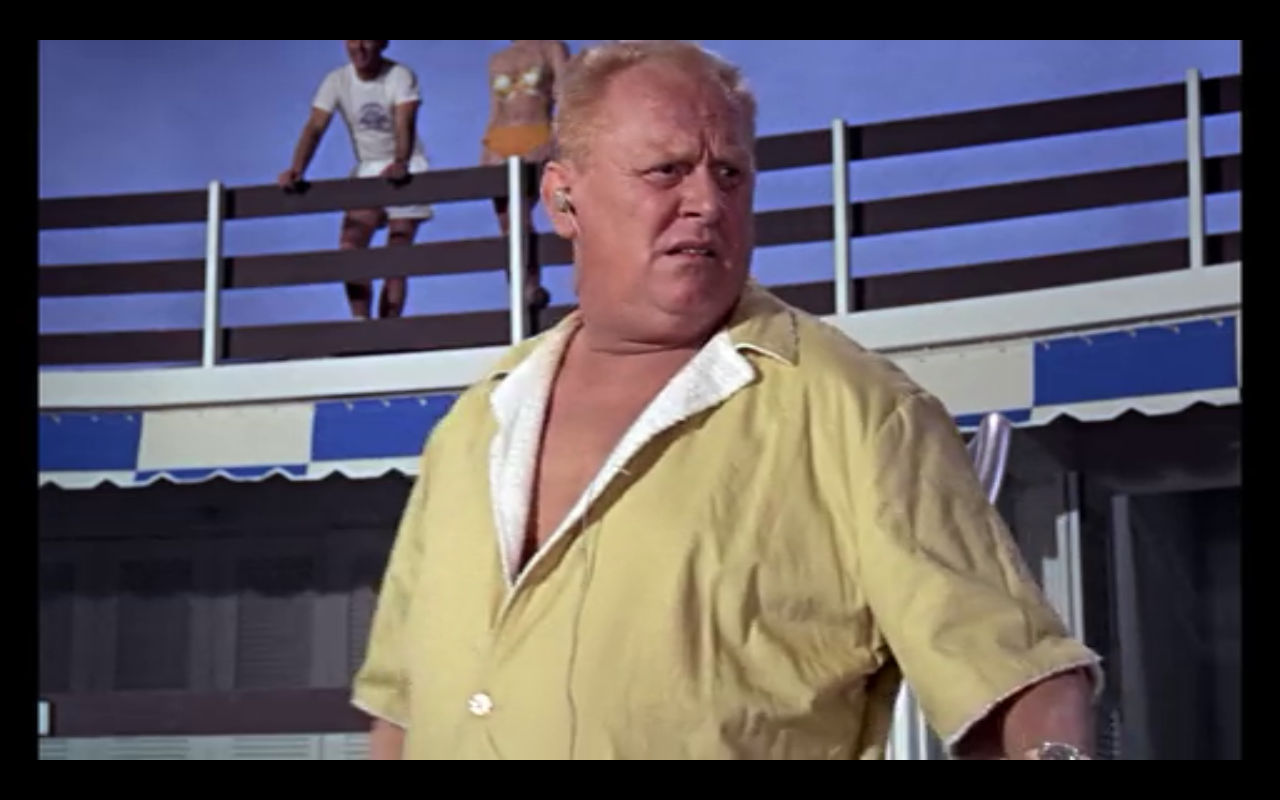
The main villain of the film, Auric Goldfinger, a portly man obsessed with gold, checks off all the super villain boxes. A wardrobe that seems to consist entirely of clothes to represent his favorite thing. A hidden lair complete with penis-zapping, impossibly slow-moving lasers. A weird ability to defy logic and science by killing people with body paint. And, most importantly, an insane mute sidekick named Oddjob whose imposing stature is matched only by his deadly choice of headgear.

3. The Greatest Named Bond Girl. Ever.


Here she is, ladies and gentleman, Miss...Pussy Galore. If you can say that name without snickering, congratulations, you are way more mature than I. In a series where doctors are named Christmas Jones and tarot card readers are named Solitaire, you know that a well-named Bond girl is an essential element to the films. And although many girls have entered the running for the title of most outlandishly dirty moniker (nice try, Honey Ryder and Holly Goodhead), the honor (Blackman) is snatched up by Pussy Galore.

4. The gadgets


The two previous Bond films never used the gadgets in quite the same way that Goldfinger does and ever since they have easily become a Bond essential. The Aston Martin soon became synonymous with the spy, but I'm sure people wanted to be able to purchase the version in the film. Equipped with a license plate that changes, an ejector seat, wheel-shredding spikes, and handy oil dispenser (just to name a few features) the sports car is just what every globe-trotting, international man of mystery needs.

5. Girls, Girls, Girls


Yes, to know Bond is to know his prowess with the ladies. And the Bond Girls are all apart of the sexy fantasy of the Bond world. But in Goldfinger there's Jill Masterson , the ill-fated beauty responsible for the film's most iconic image, her sister, the gun-toting, revenge-seeking, unfortunately named Tilly, and an unnamed conquest at the beginning of the film that happens to be the subject of my Best Shot:


At some point, I'm sure all of the woman Bond has bedded have just become a faceless number, which is why I wanted to focus on this poorly-treated conquest. Just as she is about to get down and dirty with Bond, an assassin appears to take him down. But Bond notices the lumbering man's presence in the reflection of her eye. It serves as a metaphor of how Bond is constantly looking past woman, not truly getting to know them as humans, and focusing on what they reflect back to him. This time it's his love of danger that interest him more and the poor girl literally gets tossed aside as he uses her as a human shield to deflect the blows. That Bond is a cad. But the ladies still seem to love him.

Tuesday, June 3, 2014

Life Lessons Courtesy of 'Zorba the Greek'


Are you a listless British writer in need of some forced seize-the-day type lectures from a scruffy, older faux-Greek, vaguely Mexican man? Then come to the exotic isle of Crete! It's not just a great place to get away, there's so much to be learned from life while you're there. Let Zorba lead the way along this journey of discovery. Here are some basic truths from Zorba the Greek (1964). Opa!
  • Alan Bates is hot. Why didn't someone tell me this sooner? There's a scene where he's wearing glasses and being all moody that made me swoon.
  • If they ever make a Anthony Quinn biopic, no one else can play him except Javier Bardem. They have the same profile! 
  • Everyone on Crete is a bunch of assholes. They seem to always be together in huge groups just waiting to cause problems. I mean, they steal goats from people for no reason and generally make everyone feel miserable. There's a reason people from there are called Cretins.*
  • If you are a woman thinking of going to Crete, I would seriously reconsider it. You will either a) have stones thrown at you like some biblical Jezebel b) have all of your possessions stolen from your home even before your corpses is cold c) or, you know, you'll just be killed for something that is somehow your fault. Let the good times roll!
  • When your elaborately built, yet poorly constructed pulley system to transport logs falls apart, oh, well - just eat some beachside roasted lamb!
  • Dancing is the solution. To what, you ask? Everything. Put your arms up and shuffle around.
  • "Why do we have hands? To grab!" I'm pretty sure is the motto of every date rapist.
  • But most importantly (and the reason for this post) the Best Shot of the Film (for this week's Hit Me With Your Best Shot from The Film Experience):

Despite the bad behavior of its men (prostitutes! misogyny! violence!), it seems to all be watched over with a blind religious eye. The stoning and murder of a character takes place right outside the church while the town is at mass. Characters clasp at crosses like it will magically save them from the evils around them (or the one's they've committed). This shot of a group of monks (all the people on this island are always in packs) tentatively approaching a make-shift cross that Zorba has created (after they mistakenly take him for the devil incarnate) shows that despite the people of Crete's belief in the power of Religion, the institution is just as superstitious, tentative, and fearful as its followers. And after examining the contents of the jug, they discover that Zorba has replaced the water with wine (a miracle!). The monks then proceed to become drunk, indulging in the debauchery that Zorba so often philosophizes about. He's always teaching some sort of lesson.

* This is just an observation from the film and does not represent the actual people of Crete. I hope.